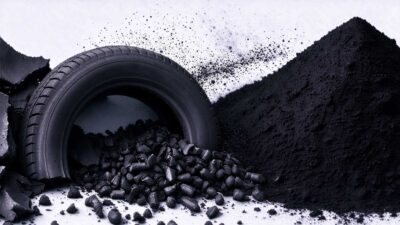
A JACAN turnkey rCB production line converts crude tire pyrolysis char into fine, graded recovered carbon black powder. The full installation follows 6 main phases: engineering & site preparation, factory acceptance test, logistics & delivery, on-site mechanical & electrical erection, commissioning, and final site acceptance & handover. The whole line includes pre-crushing, multi-stage magnetic separation, drying, grinding, air classification, dust collection, pneumatic conveying, PLC control, and automatic packaging.
Phase 1: Engineering & Site Preparation (Pre-Shipment)
- Confirm final technical specification: target throughput, PSD (D90/D97), metal impurity limit, moisture requirement, and workshop layout. JACAN provides CAD layout drawings, foundation drawings, utility requirement lists, and safety design documents.
- Civil construction: Build reinforced concrete foundations with load capacity matching heavy equipment. Reserve anchor bolt positions, maintenance access, and safety zones.
- Utility preparation:
- Power supply: 380V/415V three-phase power, proper grounding for anti-static and dust explosion protection.
- Compressed air: Dry, oil-free compressed air for jet mill, pneumatic conveying and valve actuation.
- Ventilation & negative pressure exhaust system, explosion relief panels, inert gas (nitrogen) pipeline if required for high-grade rCB.
- Prepare unloading space, forklift/crane access, and raw material storage silos.
Phase 2: Factory Acceptance Test (FAT) Before Shipment
All core modules are assembled and tested at JACAN factory before packing.
- Run no-load test and material trial with pyrolysis char similar to your feedstock.
- Verify capacity, particle size, magnetic separation performance, sealing and PLC automatic control.
- Record all parameters, inspect ceramic liners and non-ferrous contact parts for contamination control.
- Customer or third-party inspector witnesses FAT and approves equipment before shipment.
Phase 3: Shipping & Unloading
Equipment is packed into containers, split into modules. Unload in the correct installation sequence: large silos and heavy mills first, then auxiliary units, pipelines, cyclones and baghouses. Inspect all packages for damage and check spare parts list upon arrival.
Phase 4: On-Site Installation & Erection
- Mechanical positioning: Place each unit, level and anchor the main mill, classifier, dryer and magnetic separators according to layout drawings.
- Piping assembly: Connect material pipelines, air ducts, compressed air lines and dust extraction pipelines. Eliminate dead corners to avoid powder accumulation and cross-contamination.
- Electrical & control wiring: Wire motors, sensors, online particle detectors, metal detectors and PLC cabinet. Complete earthing and static protection for all powder contact components.
- Sealing check: All circuits adopt negative pressure closed design to stop powder leakage and external dust contamination.
Phase 5: Commissioning & Parameter Tuning
- No-load test: Run all individual machines separately to check rotation, vibration, temperature and safety interlock.
- Dry cycle test: Run the whole closed loop without feed material to verify air flow, classifier speed and automatic control logic.
- Raw material trial run: Start with low feed rate, gradually ramp up.
- Adjust magnetic separators to remove residual steel wire.
- Tune dryer temperature to control feed moisture below 2%.
- Optimize mill pressure and turbo classifier speed to hit target PSD.
- Test finished rCB for metal residue, ash, dispersibility and color consistency.
- Troubleshooting: Fix caking, blockage, wear and contamination issues. Train operators and maintenance staff on operation, recipe setup, cleaning and safety protocols.
Phase 6: Site Acceptance Test (SAT) & Handover
Run continuous stable production for agreed hours to meet rated capacity and product quality standards. After passing SAT, sign acceptance documents, start warranty period, and receive full operation manuals, P&ID drawings, spare parts list and after-sales support.
Critical Safety Notes For RCB Line Installation
- Pyrolysis char powder is combustible; install explosion venting, anti-static grounding and spark detection.
- Isolate different rCB grade pipelines to avoid cross-contamination.
- Use non-ferrous or ceramic-lined contact parts for high purity tire-grade rCB.
Typical Timeline
- Engineering & civil work: 4–8 weeks
- Equipment manufacturing & FAT: 8–16 weeks
- Shipping & on-site installation: 4–10 weeks
- Commissioning and SAT: 2–4 weeks